
The Hidden Drivers of Medical Loss Ratio: Why an Integrated Approach Delivers Better Performance

Medical Loss Ratio (MLR) has long been one of the defining measures of financial performance for health plans. While MLR is often associated with reducing medical costs, sustainable improvement rarely comes from cost cutting alone. Instead, organizations improve MLR by optimizing clinical, operational, and financial processes that influence the cost and quality of care.
Today’s health plans are balancing rising medical and pharmacy costs, workforce shortages, increasing regulatory requirements, and growing expectations around quality and member outcomes. While many organizations focus on individual initiatives, such as utilization management or care management, sustainable improvement requires a broader view.
MLR is the result of countless operational, clinical, and financial decisions made across the enterprise.
Solving these challenges requires more than expertise in one discipline. It requires a coordinated approach that brings together strategic advisory services, clinical execution, compliance and audit expertise, and operational support. That’s the foundation of Alerion’s MLR & Cost of Care Assessment, which integrates the specialized capabilities of Rebellis Group, Toney Healthcare and Advent Advisory Group into one comprehensive solution for health plans.
Looking Beyond Traditional Cost Management
When organizations look to improve MLR, the focus often begins with medical management. While that’s an important piece of the puzzle, it’s rarely the only opportunity.
Provider performance, pharmacy management, risk adjustment, quality initiatives, compliance, workforce strategy, and operational efficiency all play a role in controlling the cost of care and improving financial performance.
The challenge isn’t identifying one area to improve—it’s understanding how these functions work together and where inefficiencies are creating unnecessary costs.
For organizations participating in Medicare Advantage, bid timing is an additional consideration. While 2027 bids have already been submitted, plans can compare 2026 bid assumptions with actual performance to identify variances and strengthen future bid development. Similar retrospective analyses can also help Medicaid and commercial plans refine forecasting, pricing assumptions, and operational strategies.
Breaking Down Organizational Silos
Many health plans manage these functions independently. Clinical teams focus on care delivery. Operations focuses on efficiency. Finance monitors performance. Compliance prepares for audits.
Each department has its own priorities, but opportunities are often missed when no one is looking across the organization as a whole.
The most successful health plans evaluate the complete picture, identifying where performance gaps, cost leakage, and operational inefficiencies intersect.
From Insight to Execution
Another common challenge is moving beyond recommendations.
Many organizations receive assessments that identify opportunities but are left to implement the changes themselves. Without the right expertise and resources, even the best recommendations can stall.
That’s where Alerion is different.
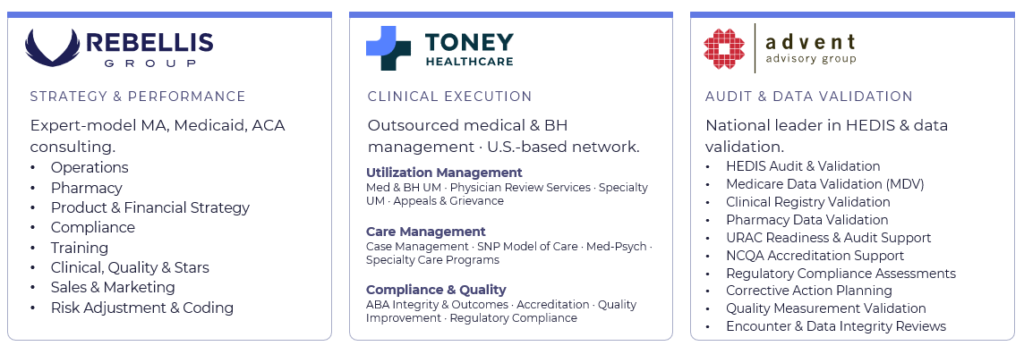
Rather than engaging multiple firms, health plans gain access to an integrated platform built around three specialized capabilities:
- Rebellis Group provides strategic advisory services, regulatory expertise, operational performance improvement, and Medicare Advantage consulting.
- Toney Healthcare delivers clinical operations, utilization management, physician leadership, care management, and workforce solutions.
- Advent Advisory Group provides audit, compliance, quality validation, HEDIS, CMS data validation, and accreditation expertise.
Together, these capabilities enable Alerion to help organizations move seamlessly from assessment to execution through one accountable partner.
A Comprehensive Approach to Performance
Improving MLR requires more than cost cutting. It requires understanding the operational, clinical, financial, and compliance factors that influence performance across the enterprise.
The MLR & Cost of Care Assessment evaluates key performance areas, including:
- Medical Management
- Provider Performance
- Pharmacy Management
- Risk Adjustment
- Quality & Stars
- Compliance & Audit Readiness
- Workforce & Clinical Operations
The result is a prioritized roadmap that helps health plans identify where they can reduce medical expense, improve operational performance, strengthen compliance, and optimize financial outcomes.
Unlike traditional consulting firms that stop with recommendations, Alerion helps organizations implement meaningful, measurable improvements. The result is more than an assessment. It’s an enterprise-wide strategy backed by the people, expertise, and execution capabilities needed to deliver measurable results. Through the combined strengths of Rebellis Group, Toney Healthcare, andAdvent Advisory Group, Alerion helps health plans improve MLR, reduce the cost of care, strengthen compliance, and enhance operational performance—from strategy through execution.
Ready to Improve MLR and Reduce Cost of Care?
The MLR & Cost of Care Assessment provides health plans with a structured evaluation of the operational, clinical, financial, and compliance drivers that influence performance. You’ll receive an executive assessment, performance heat map, opportunity sizing, and a prioritized roadmap—along with the expertise to help execute it.
Download the MLR & Cost of Care Assessment Overview or Schedule an Executive Consultation to learn how Alerion can help your organization improve performance from assessment through execution.
